Good woodwork rarely impresses with one particular thing. There is simply nothing that disturbs. The lines carry on, the doors close properly, the surfaces share the same tone. This calm is the result of decisions taken long before installation.
The continuity of the grain
On a veneered cladding the eye reads the grain of the wood first. When the leaves have been selected and laid in sequence, the surface looks like one piece, even when it runs across doors and cabinets. When they have not, every leaf looks foreign to the one beside it.
The joints
A joint is the point where two parts meet, and it cannot be avoided. The difference lies in whether it has been designed. The same width everywhere, alignment with the joints of the floor or the ceiling, and positions that follow the geometry of the space make the joint part of the composition.
Edges and corners
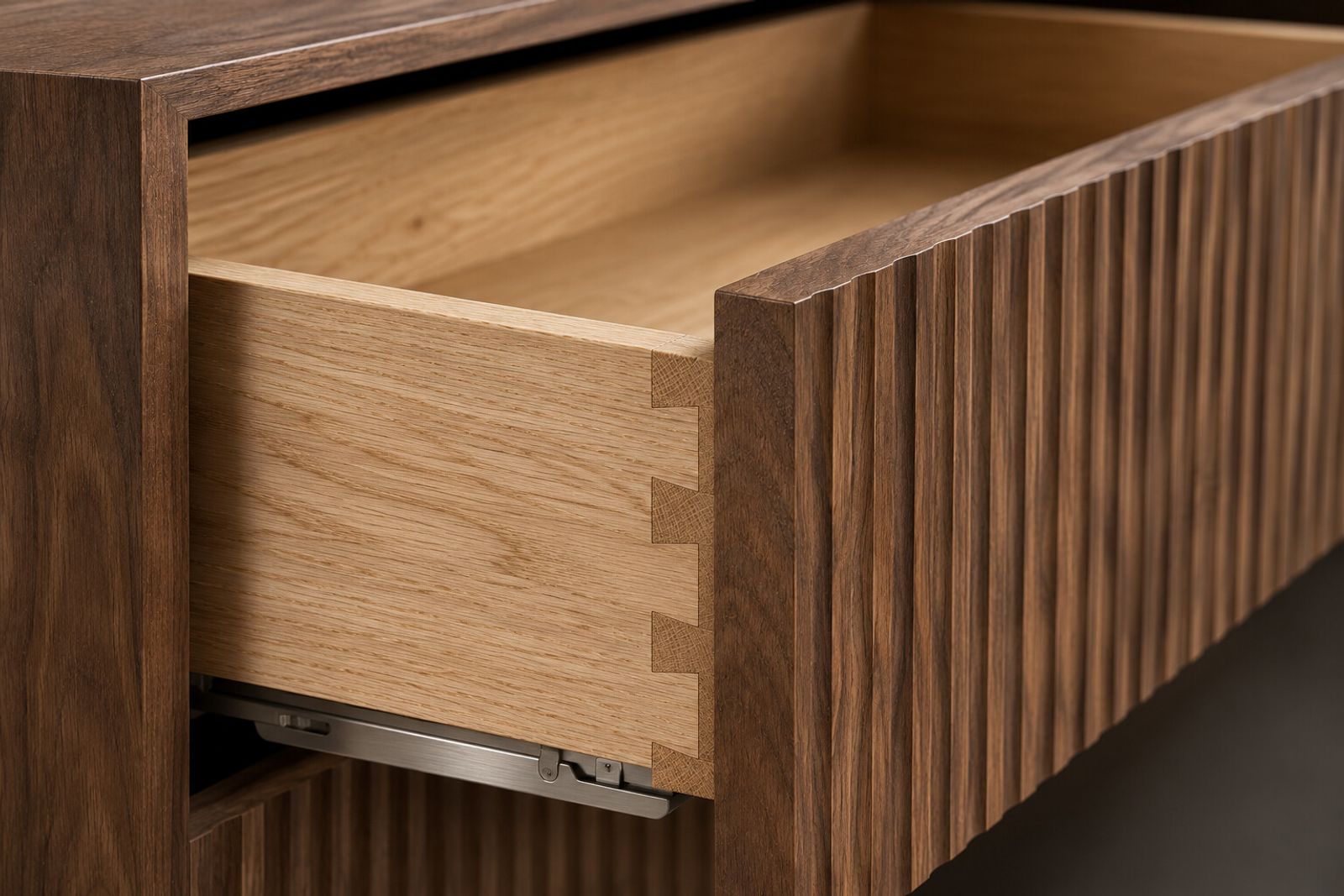
Corners show how carefully someone worked. A fluted cladding that turns the corner without losing its rhythm, an edge in the same wood as the face, an arris that stands up to use without fraying. These are details of millimetres that set one piece of work apart from another.
What is not seen
Mechanisms, runners, fixings and the inside of the cabinets are not photographed, yet they are used every day. Their quality decides whether a piece will work just as well in ten years.
The finish
The lacquer or the oil defines how the wood looks in the light and how it will age. A matt finish that lets the wood look natural, even across all surfaces and suited to the use of the space, is usually the hardest and the least visible work of the project.